Korea Runs on Hometax. And Hometax Doesn’t Speak English.
How to minimize the Tax operation when you set up office in Korea

When a foreign company sells into Korea from abroad, the tax side is almost boring. You invoice in dollars, the Korean buyer pays in dollars, and a customs broker or your own accountant handles whatever import formalities apply. Cross-border billing is a solved problem. Most founders I talk to assume the rest of Korea works the same way.
Then they incorporate a Korean entity and start doing business domestically — selling to Korean customers, paying Korean vendors, hiring Korean staff — and they hit a wall nobody put on the slide deck.
The wall has a name: Hometax (홈택스), the national tax administration system. And the thing nobody warns them about is that in Korea, you don’t simply “send an invoice.”
What an electronic tax invoice actually is
For a domestic transaction, a Korean business issues an electronic tax invoice (세금계산서, segeumgyesanseo). It is not a PDF you design in your own template and email over. It is a structured document, issued and filed through Hometax, that does several things at once:
- It is validated in real time against the buyer’s business registration number (사업자등록번호).
- It is reconciled by both sides — your record and your counterparty’s record both have to match what’s filed in Hometax.
- It carries the VAT treatment, which the tax authority later uses to assess what you owe.
In other words, the invoice isn’t paperwork that sits between you and your customer. It’s a transaction recorded directly into the tax authority’s ledger, with you as one node and your counterparty as another. That is the rail the entire domestic economy runs on — and it behaves nothing like cross-border invoicing.
Press enter or click to view image in full size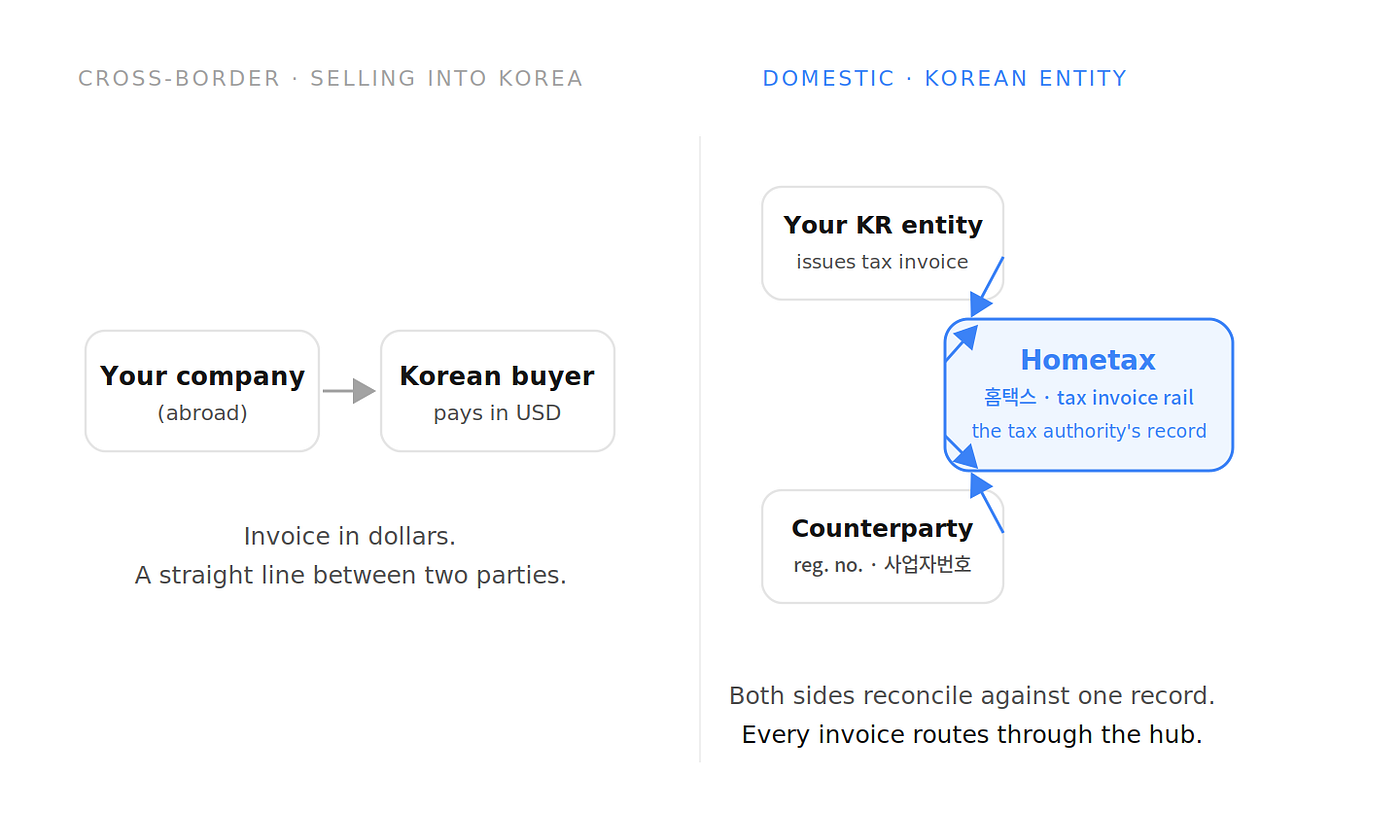
Cross-border billing is a straight line between two parties. A domestic Korean transaction routes every invoice through Hometax, where both sides — and the tax authority — reconcile against one record.
Three things foreign-only teams discover the hard way
One — the interface is Korean. Functionally, only Korean. There are English fragments, but the working surface assumes you read Korean and already know the vocabulary. The menus are not translated in any way you can operate under deadline.
Two — issuing tax invoices requires a digital business certificate (공동인증서, formerly 공인인증서) — Korea’s authentication system — tied to the company and installed on the machine doing the work. The whole enrollment flow assumes a Korean speaker is driving.
Three — mistakes aren’t typos. Get the buyer’s registration number wrong, or mis-apply the VAT treatment, and you haven’t made a formatting error. You’ve created a filing discrepancy that surfaces at quarter-end, when your numbers and your counterparty’s numbers don’t reconcile against the tax office’s.
Here’s the part most people get wrong
None of this is actually impossible for a foreign team. You can enroll the certificate. You can issue the tax invoice. Foreigners do it every day. A sharp founder will figure out a single tax invoice (세금계산서) in a day or two of digging.
The catch is that every operational task is shaped like this one.
The thing a Korean colleague does in twenty minutes costs you a day in Korean-only menus and forum threads. Payment integration, the same. Opening a corporate bank account, the same. Registering for payroll and the four mandatory insurances, the same. None of them is a catastrophe on its own. But one day here and two days there, stacked across an entire setup, becomes weeks of founder time spent learning a system you will ultimately operate through someone else anyway — plus a handful of small filing mistakes you only catch at quarter-end, when they’re more annoying to fix.
That’s the real cost. Not a single wall you can’t climb. A steady tax on every week, paid in your most expensive person’s time.
The Korean hire absorbs it — eventually
The moment you hire your first Korean employee who can operate, most of this dissolves. They open Hometax, issue the invoice, call the accountant, fix the registration number, and it’s a Tuesday-afternoon task. The friction doesn’t disappear because the system got easier. It disappears because someone on your team already speaks the system.
But that hire usually comes after you’re operating, not before. And in the gap between “we incorporated” and “we have a Korean person who can drive the back office,” the friction just sits there — taxing every week, slowing every deal that requires you to actually invoice, pay, or get paid.
What actually closes the gap
The fix is simpler than a headcount, and it’s available before you make that first hire: someone who has already mapped the order of operations.
Not someone to do it for you — you can do it. Someone who’s walked the maze and can tell you which thing to do first, and which to leave until later.
Press enter or click to view image in full size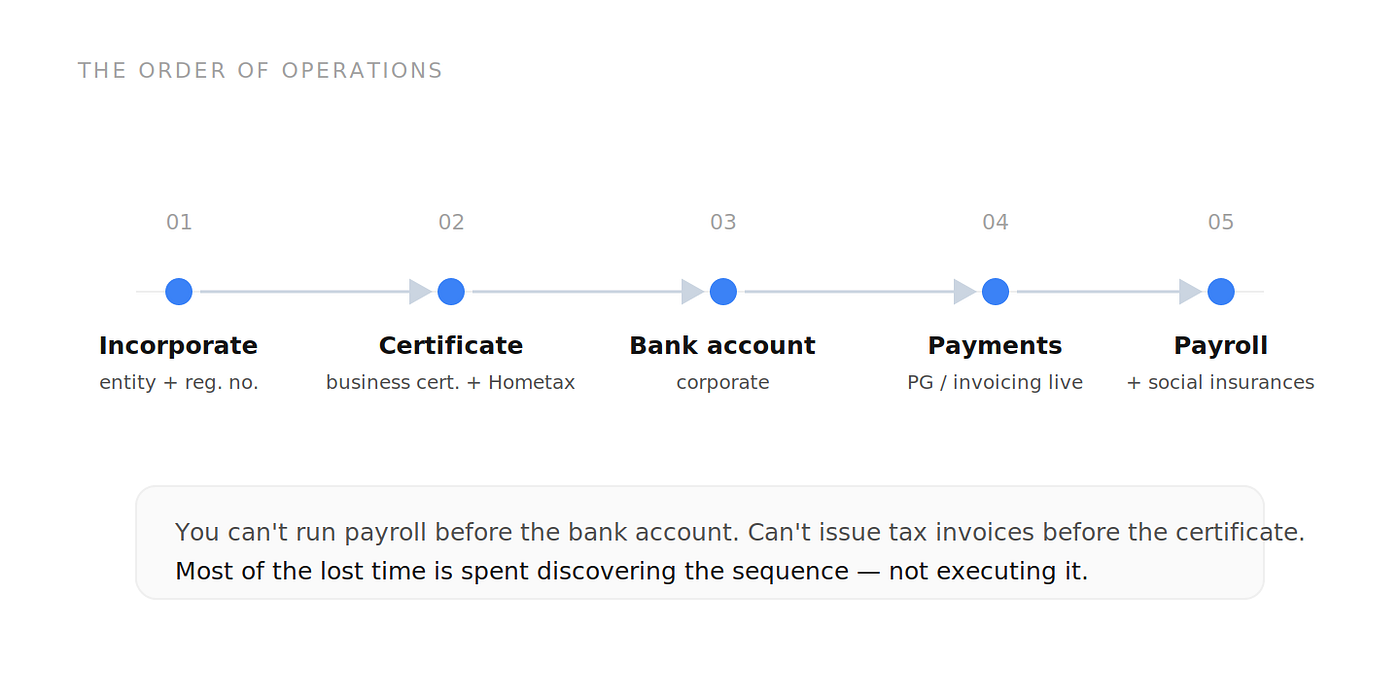
Operational setup in Korea has an order. Do it out of sequence and you stall — you can’t run payroll before the bank account, can’t issue tax invoices before the certificate. Most of the lost time is spent discovering the sequence, not executing it.
Which payment system actually fits your model. Which certificate, enrolled how. Which licensed tax accountant (세무사) to engage, and at what point — and which one actually answers in English. What to get right the first time so it isn’t a discrepancy with the tax office three months later. The specialists exist for each piece. What’s missing, for most foreign teams, is the person who knows the sequence and the handoffs.
That’s the difference between “we incorporated three weeks ago and still can’t reliably invoice anyone” and “we knew the order, so we just moved.”
Get the next one in your inbox
One email per new post. No spam, unsubscribe anytime.
By subscribing you agree to our privacy & marketing email policy.