Why You Cannot Sprint Into Korea: Setting Up People on the Ground
Three months from filing for the visa to them actually sitting at desks in Seoul.
Bringing two programmers from Vietnam to a small Korean company took us three months.
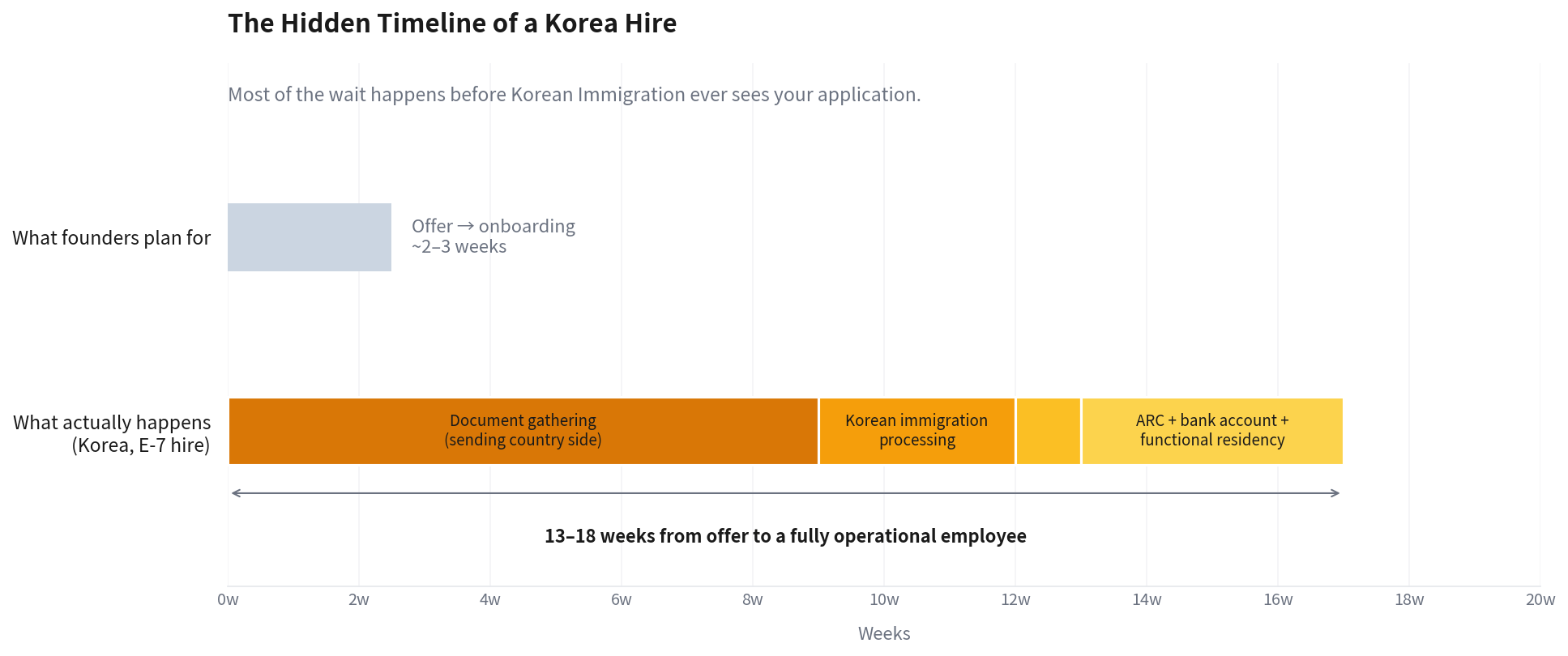
Not three months from offer letter to onboarding. Three months from filing for the visa to them actually sitting at desks in Seoul.
The bottleneck wasn’t the immigration office in Korea. It was getting the Vietnamese-side documents notarized, the offer documentation legalized, and the E-7 application package assembled — every step requiring originals, official seals, and physical mailing across borders. Korean Immigration moved their part on the standard timeline. The international paperwork dance is what ate the eight weeks.
If you are a foreign founder planning to put even one engineer in Korea, this is the part of the timeline you don’t see coming. You assume immigration is the bottleneck. It usually isn’t. The bottleneck is everything that has to be in order before immigration can do their job.
I have worked relocation in both directions — bringing foreign engineers into Korean SMEs, and supporting expats coming into Korea for Apple, Intel, McKinsey, and ASML at Allied Korea. The budgets differ wildly. The wall does not. Big multinationals just hire vendors who absorb the friction; startups don’t, and that’s why their timelines slip.
Here is what actually breaks.
Visas don’t move at startup speed
The E-7 visa (specialized activity) and D-7 (intra-company transfer) are the two most common for technical hires. Both typically take 8 to 12weeks of processing — but processing is the last leg, not the whole journey.
For E-7 specifically:
- You need your Korean entity incorporated first. No entity, no employer-side documents.
- You need a job description that maps to one of the designated E-7 activity codes. “Software engineer” is fine; “growth hacker” is not. The wording on the contract has to match.
- You need the candidate’s diploma, employment history, and professional certifications — originals, notarized, and in many cases apostilled depending on the country.
- You need the offer letter in a specific bilingual format that the immigration office will accept.
In our case, the three-month clock was mostly spent getting documents from Vietnam — diploma originals, employment verification, all notarized and shipped. Korean Immigration processed our submission on a normal timeline once we got there. Founders consistently underestimate this prep phase because it is invisible from their side. It is happening in another country, in another language, and you cannot see what is taking so long until something fails.
Practical implication: start the document-gathering process at the same time you send the offer letter, not after acceptance.
The Foreign Residence Card takes up to 90 days after entry to issue
This is the bullet most founders skip past. They should not.
Once your employee arrives in Korea on the E-7 visa, they have 90 days to register and receive their 외국인등록증 (Alien Registration Card, often shortened to ARC). Until that card is physically in their hand, they cannot:
- Open a Korean bank account in their name
- Sign a long-term lease (most landlords require ARC for foreign tenants)
- Sign up for postpaid mobile service — only prepaid plans are available
- Subscribe to most domestic SaaS or payment services that require Korean identity verification
- Receive their first paycheck without major workarounds
The 90 days is a ceiling, not a target. Realistic processing is 2 to 6 weeks depending on the immigration office. But until then, your engineer is in legal-administrative purgatory — valid visa, cannot fully function as a resident.
What companies actually do during this window: cover short-term serviced apartments for the first one to two months, advance cash for living expenses, and route the first payroll through a workaround. None of this is in the relocation guides because it sounds embarrassing, but it is universal.
International school slots are not elastic
If your employee is bringing a family, the school question may determine whether the move happens at all.
The top international schools in Seoul — Seoul Foreign School (SFS), Korea International School (KIS), Dwight School Seoul, Yongsan International School, British School Seoul — run waitlists of 6 to 18 months for some grades. Mid-year transfers are near impossible. Some schools have entry years (kindergarten, grade 6, grade 9) where new slots open up; outside those windows, you wait.
This matters even if your specific candidate is single, because:
- They may have a partner or family they are considering bringing later
- They are watching how their colleagues’ family moves play out
- The reputation of “this company makes you choose between your career and your kid’s school” travels fast
For Korean public schools, foreign children can technically enroll, but full-Korean curriculum and limited English support make it a non-starter for most expat families.
Practical implication: if your candidate has school-age kids, the school admission decision often arrives months after the offer. Plan your hiring timeline accordingly, or expect to lose candidates at the last step.
Korean rental works on capital, not income
Korean residential real estate uses two main rental structures:
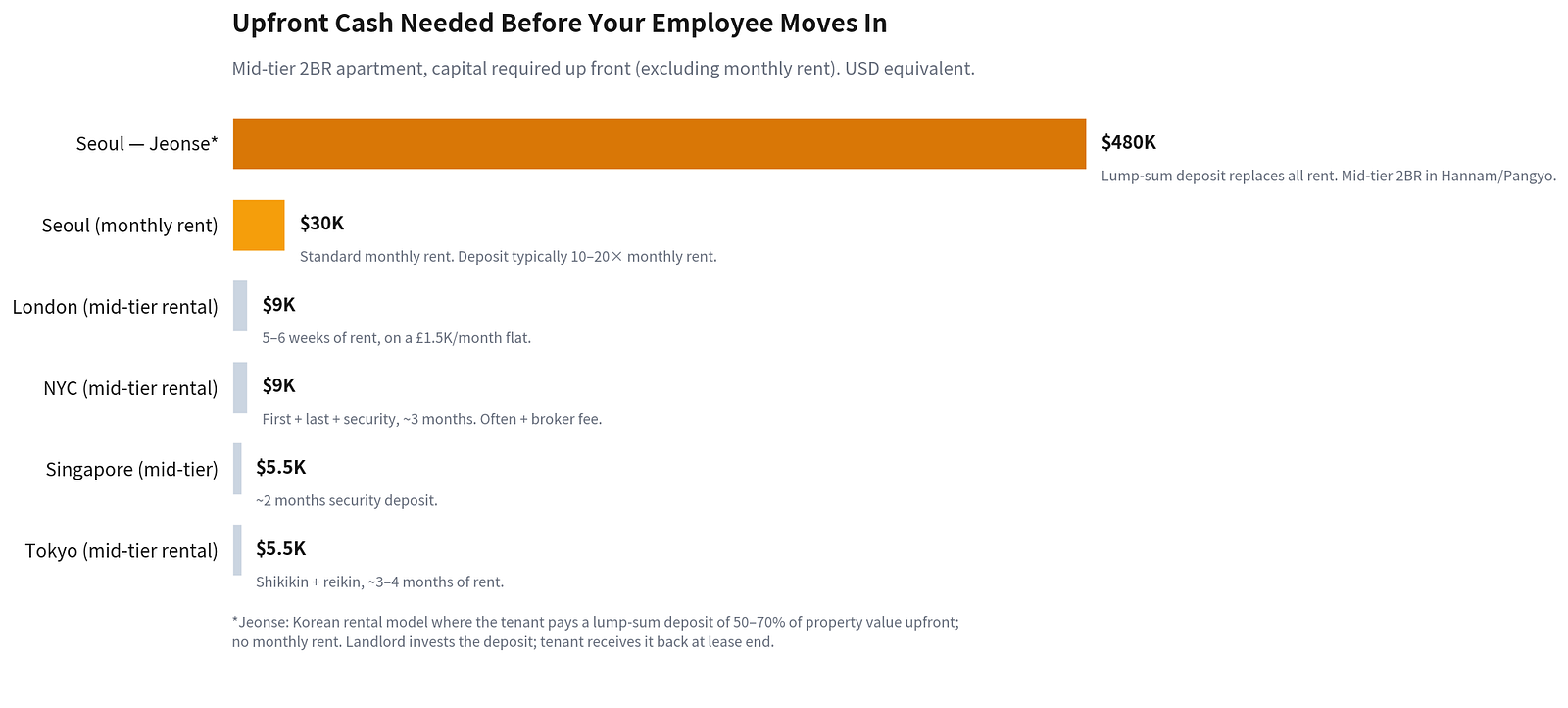
전세 (jeonse): No monthly rent. Instead the tenant pays a deposit of roughly 50 to 70 percent of the property value upfront. The landlord holds and invests the deposit; tenant lives rent-free and gets the deposit back at lease end. Most foreign companies cannot do this — the capital outlay per employee is enormous.
월세 (wolse): Monthly rent, but with a deposit usually 10 to 20 times the monthly rate. A ₩3M-per-month apartment in Hannam typically requires ₩30M to ₩50M deposit. Less than jeonse, but still significant cash upfront.
For company-name leases (which let you expense the rent as a business cost), there is an additional wrinkle: you need a Korean corporate entity that already exists. The lease cannot be signed under a foreign parent. So new market entrants get stuck in a chicken-and-egg loop — they need an office to incorporate, and they need to be incorporated to sign the lease.
The workaround is to have a relocation vendor or relocation-friendly real estate agent sign on behalf of the entity-in-progress. This costs more and adds steps, but it works. The vendors who do this well know the ten apartments in each expat district that accept this arrangement, and the ones that do not.
Working with me
I spent more than ten years working inside Korean companies — at SME startups, mid-market firms, and as account manager for global enterprise clients (Apple, Intel, McKinsey, ASML) at Allied Korea. I do 1:1 strategy sessions for foreign teams considering or already in Korea.
If you are planning your first Korean hire, or your fifth, and you want a clear map of what to expect.
Get the next one in your inbox
One email per new post. No spam, unsubscribe anytime.
By subscribing you agree to our privacy & marketing email policy.